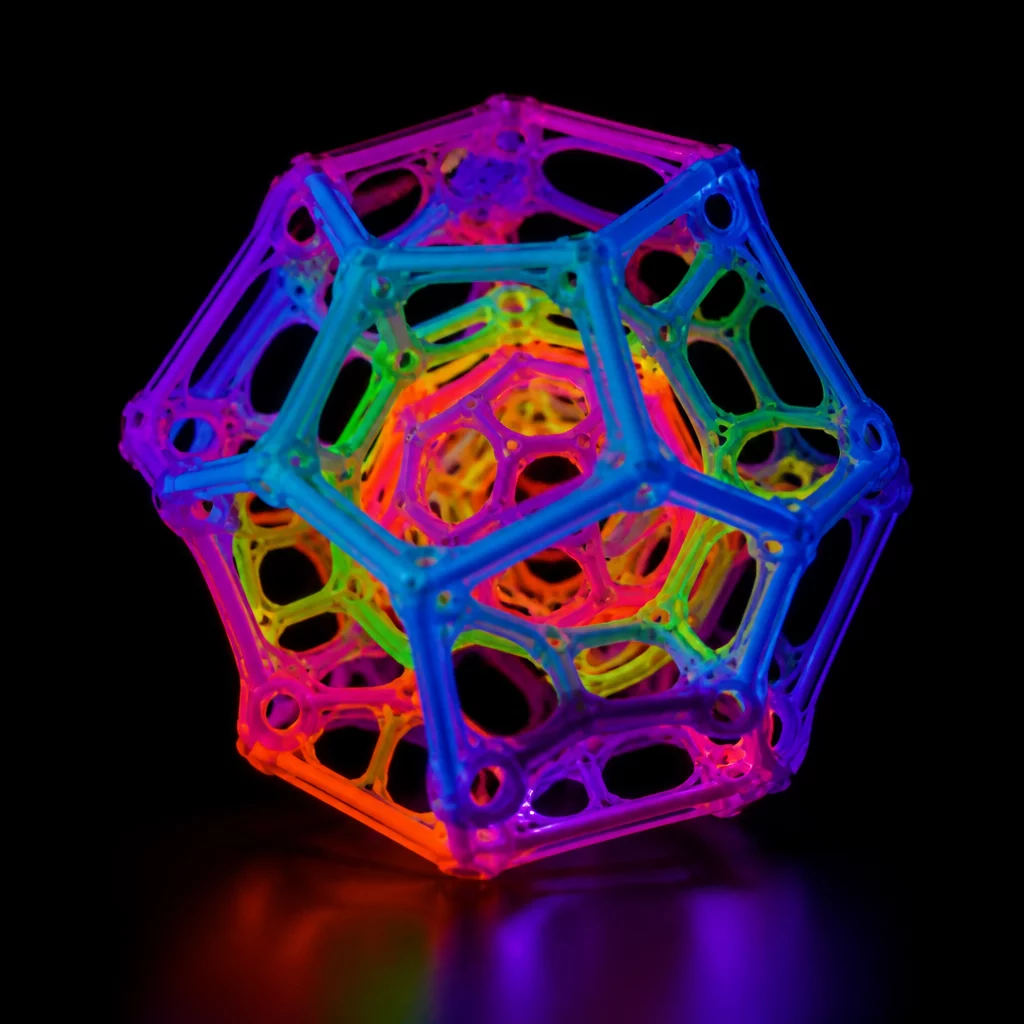
Protopasta, a brand renowned for pushing the envelope of PLA-based composites, has officially announced the launch of its Quantum Dot Filament. This groundbreaking material integrates semiconductor nanocrystals directly into the polymer matrix, offering a unique combination of visual brilliance and technical utility. Unlike standard phosphorescent materials that lose their glow quickly, this filament relies on high-efficiency fluorescence, reacting instantly to ultraviolet excitation with intense, saturated color emission.
The Science of Quantum Dots in Additive Manufacturing
Quantum dots are tiny particles, often consisting of only a few hundred atoms, that possess unique optical and electronic properties due to quantum mechanics. In the context of 3D printing, Protopasta has successfully stabilized these particles within a bioplastic carrier. It allows for a print that not only looks stunning under blacklight but also maintains the mechanical reliability that professional users expect from Protopasta’s HTPLA line. The inclusion of these nanocrystals does not significantly alter the printability of the material, making it accessible to standard FFF (Fused Filament Fabrication) systems.
Quality Control and Part Verification Applications
Beyond the aesthetic appeal for the maker community, the Quantum Dot filament holds significant promise for industrial verification processes. By adjusting the size of the quantum dots during production, the emitted wavelength can be precisely tuned. It enables a form of "spectral tagging" where a printed part can be identified or verified by its specific light emission profile. In a quality control environment, this helps technicians ensure that the correct material has been used or that the internal geometry meets specific density requirements through UV-based scanning.
- Luminescent Stability: High resistance to quenching compared to organic dyes.
- Thermal Resistance: Retains its optical properties even after the HTPLA heat-treating process.
- Layer Adhesion: Excellent inter-layer bonding, consistent with high-grade PLA.
- Traceability: Potential for covert security marking within functional prototypes.
When working with this material, users should ensure their extruders are calibrated for standard PLA temperatures, typically around 205°C. It is advisable to use a clean bed surface, such as PEI or blue painter's tape, to capture the intricate details that the fluorescent properties highlight so well. The resulting parts are not just components; they are data-rich objects capable of interacting with their environment in new and measurable ways.